 EN
EN  FR
FR  NL
NL 
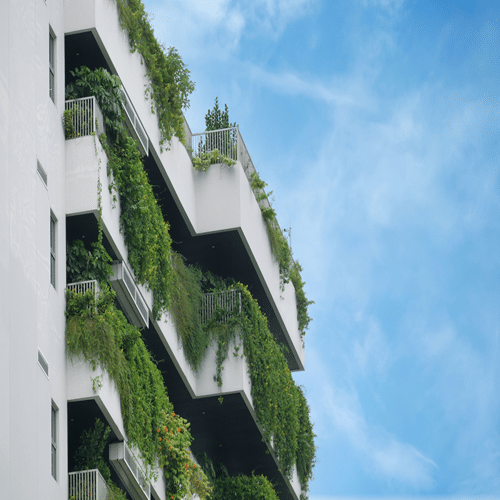
As heatwaves become more frequent and intense across Europe, one question springs to mind: how can we design buildings that remain comfortable without relying on air conditioning at all times?
Eco-construction is now emerging as a particularly promising solution. By prioritising natural, locally sourced and minimally processed materials, this approach not only reduces the carbon footprint of buildings but also significantly improves their thermal comfort.
Buildings that are naturally cooler
Unlike many modern buildings, which were designed primarily to retain heat in winter, eco-designed buildings are better able to regulate temperatures throughout the year.
Materials such as rammed earth, timber, straw, hemp and cellulose wadding have thermal phase-shifting properties that slow down the penetration of heat into buildings. As a result, even in very hot weather, indoor temperatures remain significantly more comfortable.
Examples from France show that some eco-friendly buildings have managed to maintain an indoor temperature up to ten degrees lower than the outside temperature, without the use of air conditioning.
A major climate and energy challenge
The construction sector accounts for a significant proportion of greenhouse gas emissions and energy consumption in Europe. Poorly insulated homes require more energy to be heated in winter and cooled in summer.
Green building enables action to be taken on two fronts:
- To reduce emissions associated with the manufacture and transport of materials.
- To reduce the building’s energy requirements throughout its entire lifespan.
In light of the EU’s climate targets, improving the thermal performance of the building stock is therefore a key lever.
The challenge of the initial cost
Despite its many advantages, green building is still more expensive to construct than a conventional building. Industry professionals generally estimate this additional cost to be between 15 and 20 %.
However, this view does not always take into account the long-term savings:
- Reduced heating and air-conditioning costs.
- A better quality of life.
- Property valuation.
- Improved durability of buildings.
The higher initial investment can therefore be offset by substantial savings over the years.
Local authorities leading by example
Some towns have already begun the transition to bio-based materials for their renovation and construction projects. The use of wood, plant-based wool, hemp and straw is gradually becoming more widespread in public buildings and social housing.
To accelerate this trend, several stakeholders in the sector are calling for further financial incentives, including increased subsidies and a more favourable tax regime for sustainable materials.
In conclusion
Green building is much more than just an environmental trend. In the face of increasingly frequent heatwaves, it offers a practical solution for creating buildings that are more comfortable, more energy-efficient and better suited to the climate of the future.
Whilst the initial cost remains a barrier, the environmental, economic and health benefits strongly argue in favour of the gradual roll-out of these practices.
Source of the original article: Euronews – Heatwave: eco-friendly construction keeps buildings cool, but at what cost?
👉 https://fr.euronews.com/2026/07/09/plus-chere-mais-plus-fraiche-leco-construction-garde-les-batiments-au-frais-en-canicule